

TL;DR
A vulnerability introduced by a 2023 security fix left every major Linux distribution exposed for 2.5 years. Miggo extends the research community's work with runtime detection that doesn't depend on patch status.
Tel Aviv, Israel, June 17, 2026 — Miggo Security, leader in AI Runtime Security and Application Detection and Response (ADR), today published research completing the first self-contained, privilege-escalation exploit for CVE-2026-23111, a Linux kernel privilege escalation that left every major distribution exposed for approximately two and a half years. The detector catches the attack by its runtime behavior, protecting systems whether or not the patch has been applied.
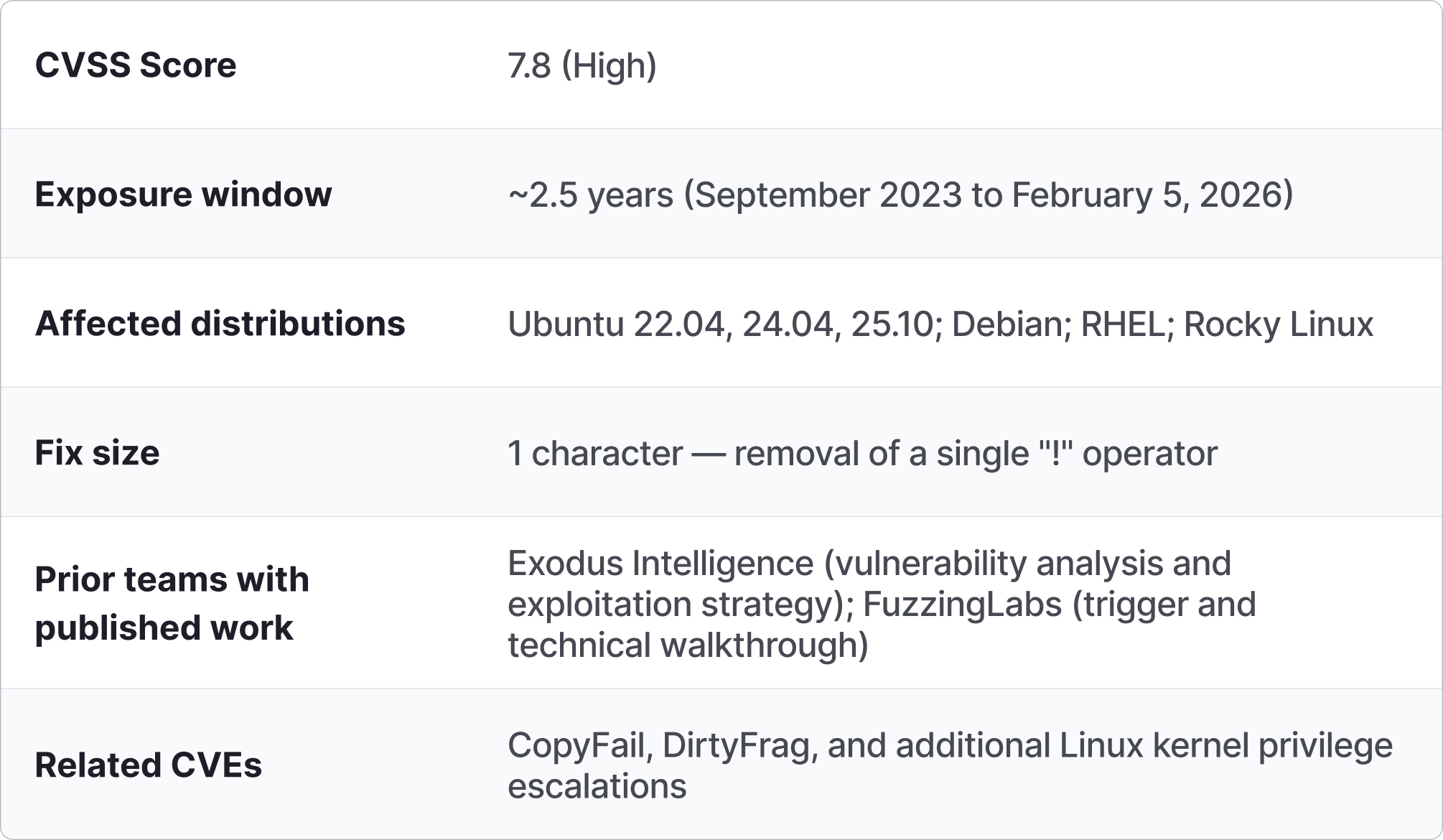
In 2023, a fix for an earlier Linux kernel flaw introduced a single backwards logic check in the nftables firewall subsystem. That one inverted "not" operator left every major Linux distribution, including Ubuntu, Debian, RHEL, and Rocky Linux vulnerable to a full privilege escalation for approximately two and a half years. The upstream fix, landed February 5, 2026, required deleting one character. CVE-2026-23111 is the latest in a pattern as it joins CopyFail, DirtyFrag, and a growing class of severe Linux kernel privilege escalation vulnerabilities that share a common characteristic: each requires driving normal kernel interfaces in an abnormal behavioral rhythm.
Miggo's work builds on serious prior research. Exodus Intelligence published the foundational vulnerability analysis and exploitation strategy. FuzzingLabs contributed a trigger and detailed technical walkthrough. Building on that foundation, Miggo's team extended the research to develop a complete proof-of-concept confirming the vulnerability is fully exploitable by an unprivileged user with no pre-conditions and to build a behavioral detector informed by that hands-on analysis. For container environments, the risk is particularly direct: an attacker inside a container can use this path to become root on the entire host.
Miggo's behavioral detector closes this gap. It hooks at the kernel's own decision points and watches for the specific sequence of nftables operations the attack requires – a pattern no legitimate workload ever produces. It catches the attack and its variants, requires no signature feed, and fires whether or not the patch has been applied.
"The industry treats kernel vulnerabilities as a patch management problem. CVE-2026-23111 shows exactly why that fails. A security patch created this vulnerability. The fix existed for months before most production systems could apply it. Runtime detection is not a fallback for when patching is slow, it is the only approach that works at the moment an attack is actually happening."
— Daniel Shechter, CEO, Miggo Security
For the full technical breakdown, refer to this post from Miggo Engineering Blogs.
Key Facts
.webp)