TL;DR
New approach applies coordinated edge and in-application mitigation, swiftly stopping active exploits while patching moves forward.
Today, we are announcing our multi-stage coordinated mitigation capabilities (Defense-in-Depth Mitigation), which enable teams to implement multiple mitigation points at the edge and runtime to stop exploits in minutes before a patch is even applied.
Attackers now turn daily vulnerability disclosures into working exploits in minutes. Patching, while becoming faster, still requires manual intervention from IT/engineering, which keeps the exploitation window open for attackers (“the patch gap”). Our latest release allows teams to close that gap by implementing AI-generated, tested, and validated mitigative controls, customized to their vulnerability setup and exposure as a stop-gap, cutting the exposure window by up to 99% while the fix follows its normal course.
"Defense-in-depth mitigation means machine-speed protection with no business interruption. For Miggo customers, it means independent yet coordinated layers of protection: one at the edge, one inside the application," said Daniel Shechter, CEO and Co-Founder of Miggo Security. "When a new exploit drops, we place the right mitigation in the right layer, on the exact path it runs, in minutes. We run tests in Miggo Labs to validate its efficacy and safety for the customer environment before it even touches their environment. That's the fastest, smartest way to mitigate whatever's coming at you."
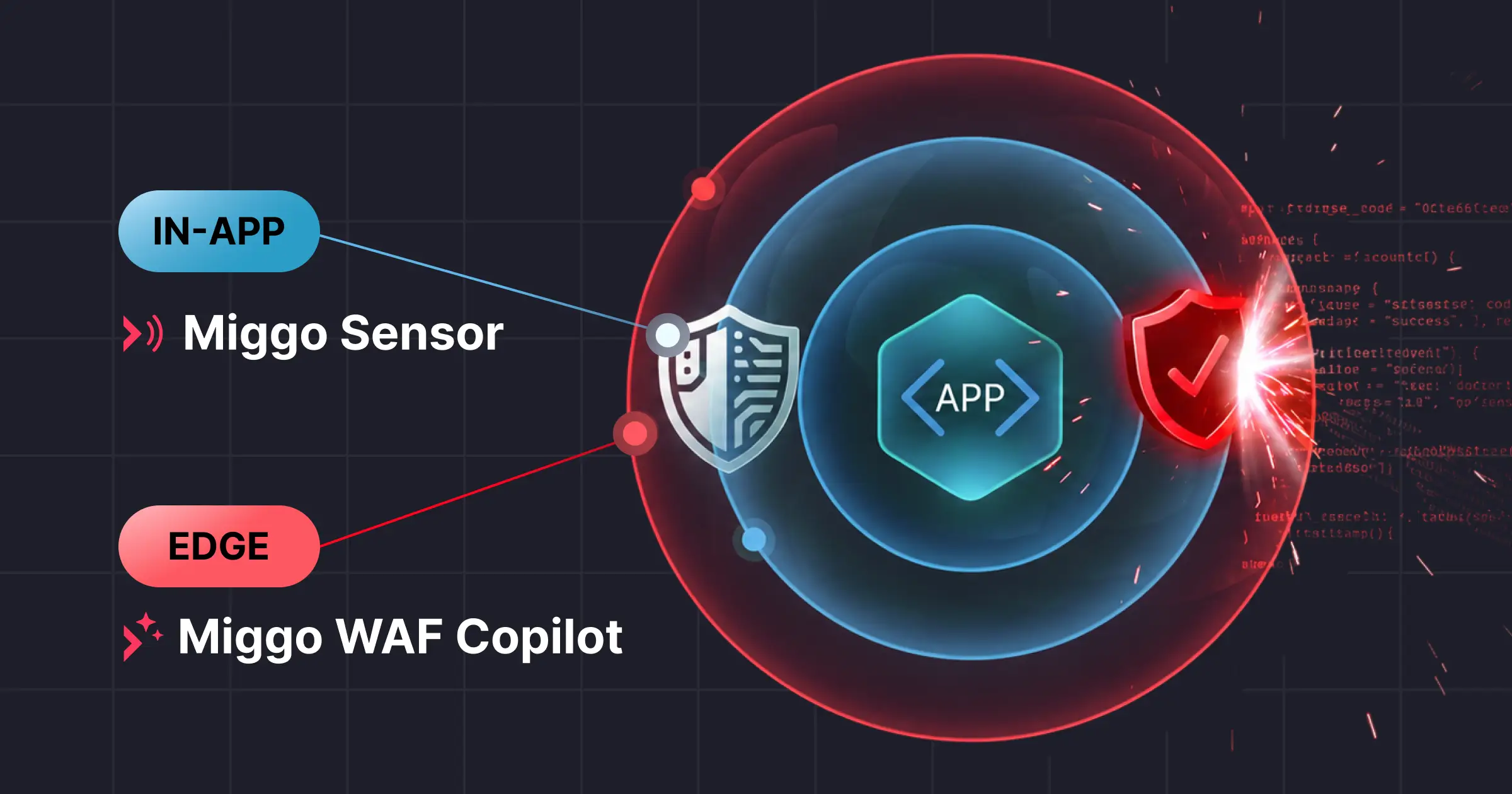
Our approach starts with the threat model rather than the CVE. Some flaws are best mitigated at the edge, where the exploit appears as a recognizable request pattern. Others must be caught inside the application, where the exploit technique actually executes: which control is correct is a property of the application and how the flaw reaches it. We deliver both layers so the right mitigation can be placed in the right location, in the context of the application, the moment a CVE drops.
Defense-in-Depth Mitigation was demonstrated against a real-world cluster of LiteLLM vulnerabilities disclosed within a single week, including a privilege escalation (CVE-2026-47102) and a remote code execution flaw (CVE-2026-40217) of the same severity. The privilege escalation, a recognizable request pattern, was blocked cleanly at the edge. The code execution flaw, where a pattern can be evaded or incomplete, was caught inside the application at the level of the exploit technique itself. Same component, two vulnerability classes, two different mitigations placed exactly where each belonged.
Key capabilities:
- WAF Copilot turns the WAF an organization has already invested in, into a real-time response. It analyzes the exploit, generates a blocking rule, then crafts variations of the attack to confirm the rule holds against more than the single payload in the proof of concept, shutting down the specific attack while normal traffic keeps flowing.
- The Miggo sensor works from inside the application, recognizing the exploit technique as it executes rather than wholesale blocking of legitimate application activity. It detects malicious execution in the affected flow, with inline blocking available in early preview, and can catch execution techniques even before a CVE is formally released.
- Defense-in-Depth by design places edge and in-application controls together, so lower-impact flaws that chain into critical ones are stopped at multiple independent barriers.
- Runtime-first mitigation reduces exposure windows by up to 99% and cuts operational overhead by 30% or more by acting in minutes, without waiting on engineering cycles.
- Context-aware placement selects the right mitigation for each flaw based on the application and how the vulnerability reaches it, rather than treating every CVE the same way.
Going to BlackHat? We will offer additional insights on Defense in Depth (and the full product offering) at Black Hat USA in Las Vegas, from August 3-6, 2026. To schedule a meeting, visit: https://calendly.com/d/cyfv-4rm-m9h/meet-miggo-at-the-blackhat-2026.
To learn more about Defense-in-Depth, request a demo here.